Tarihi Ulus Hali is not the kind of Ankara attraction where you simply arrive, photograph a monument and move on.
It is a working market—and one of the places where I think you can experience a more everyday side of Ankara.
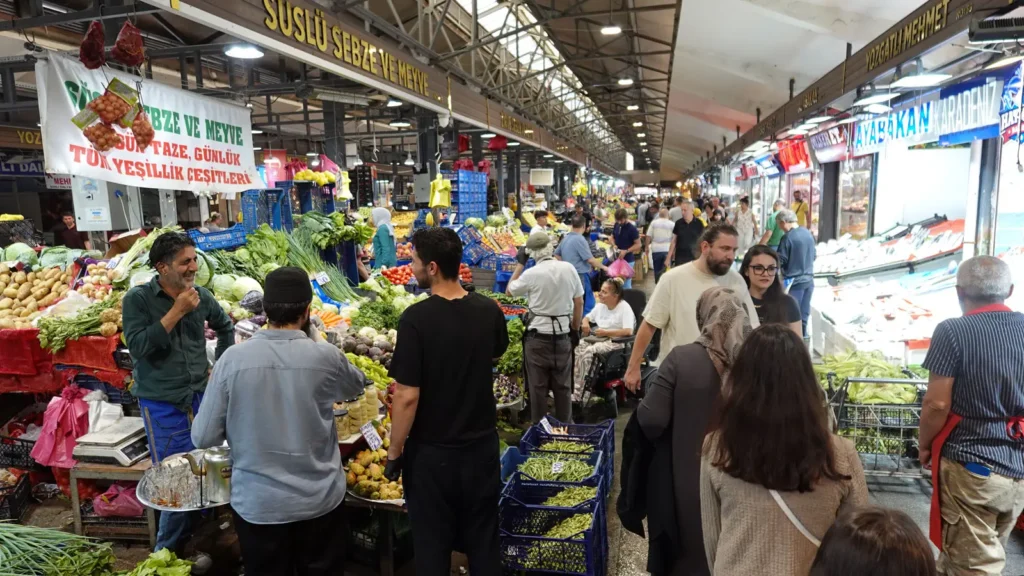
When I visited in August 2026, at around 5 p.m., the first thing that struck me was the activity. Local shoppers moved between stalls filled with vegetables, fruit and other food, sellers called out across the market, and transactions happened quickly.
That atmosphere is one of the main reasons I think Ulus Hali is worth visiting.
If your Ankara itinerary focuses mainly on museums, archaeological sites and monumental architecture, the market shows another side of the city: ordinary shopping, food and everyday interaction in one of Ankara’s historic commercial districts.
The building itself also has historical importance. Ankara Metropolitan Municipality states that Ulus Hali was designed in 1937 by Austrian architect Robert Oerley. The municipality completed a major renovation of the building in 2023, including extensive work on its roof system and market infrastructure.
That combination—a historic market building that still functions as an everyday food market—is what makes the visit interesting.
Is Tarihi Ulus Hali Worth Visiting?
For most visitors, I would not treat Ulus Hali as a major half-day attraction on its own.
Its strength is different.
It works particularly well as part of a walk through historic Ulus, especially if you are interested in food, street photography, markets or everyday Turkish life.
Best for: travelers interested in local food, markets, photography and everyday Ankara.
Main reason to visit: the atmosphere and the chance to see a functioning local market rather than an attraction created primarily for tourists.
Main limitation: if you dislike crowded, noisy shopping environments, the experience may be less appealing.
Time needed: you do not need to build an entire day around the market. It makes more sense as one stop within a wider exploration of Ulus.
One important qualification: my description of the crowd is based on my own visit. At around 5 p.m. in August, I found the market very busy. That does not mean it is equally crowded at every hour or on every day.
A Historic Market That Still Has a Practical Purpose
Ulus Hali is historically interesting because its role has not been reduced to heritage alone.
According to Ankara Metropolitan Municipality, Robert Oerley designed the market in 1937 in a modern architectural style. The municipality completed a comprehensive renovation before the market reopened in December 2023.
The renovation included replacement of the roof system, new rainwater infrastructure, renewal of central stalls and changes to flooring and other parts of the market.
You can see the long roof structure particularly clearly once you are inside.
For a visitor, however, the dates and renovation history are only part of the story.
What matters on site is that this is not a preserved market building with its commercial life removed. The building and the activity inside it still belong together.
That is a much more useful way to understand Ulus Hali than simply viewing it as a historic structure from 1937.
What the Market Actually Feels Like
Photographs show the colours immediately. They do not fully convey the pace.
During my visit, the market felt fast.
People were shopping rather than slowly walking through a tourist attraction. Sellers spoke loudly, customers stopped at counters, and transactions could happen quickly.
For a foreign visitor, that can be both interesting and slightly demanding.
I found the speed of some interactions with sellers noticeably different from a leisurely tourist market. You may have less time than expected to decide what you want while other customers are waiting.
That experience changed the way I would approach the market next time.
Rather than buying from the first stall that catches my attention, I would first walk through the market, see what is available, compare the stalls and then return to the places that interest me most.
That is especially useful because there is a lot competing for your attention.
Watch My Walk Through the Ulus Market Area
Still photographs can show the produce, fish, spices and people inside and around Ulus Hali, but video gives a much better sense of movement, sound and the street-level atmosphere of Ulus.
I also filmed the Ulus bazaar and market area while exploring Ankara. If you are planning to visit, I recommend watching the video together with this guide. It gives you another first-hand view of the area and helps show what walking through this part of Ankara actually feels like.
Watch my Ulus bazaar video on YouTube →
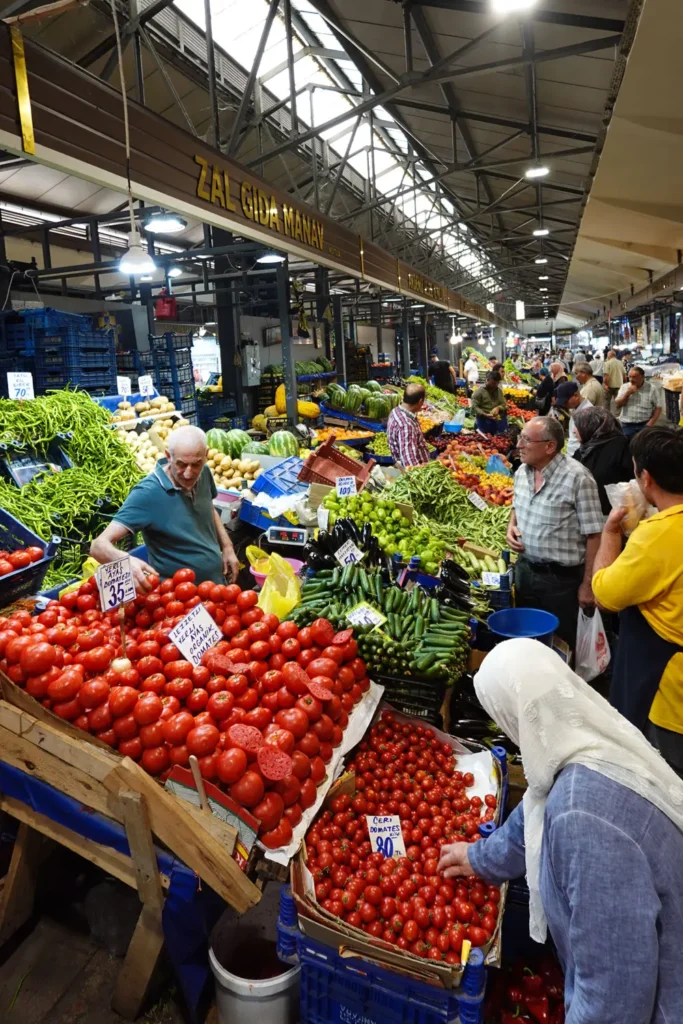
Fresh Produce: The Most Immediate Impression
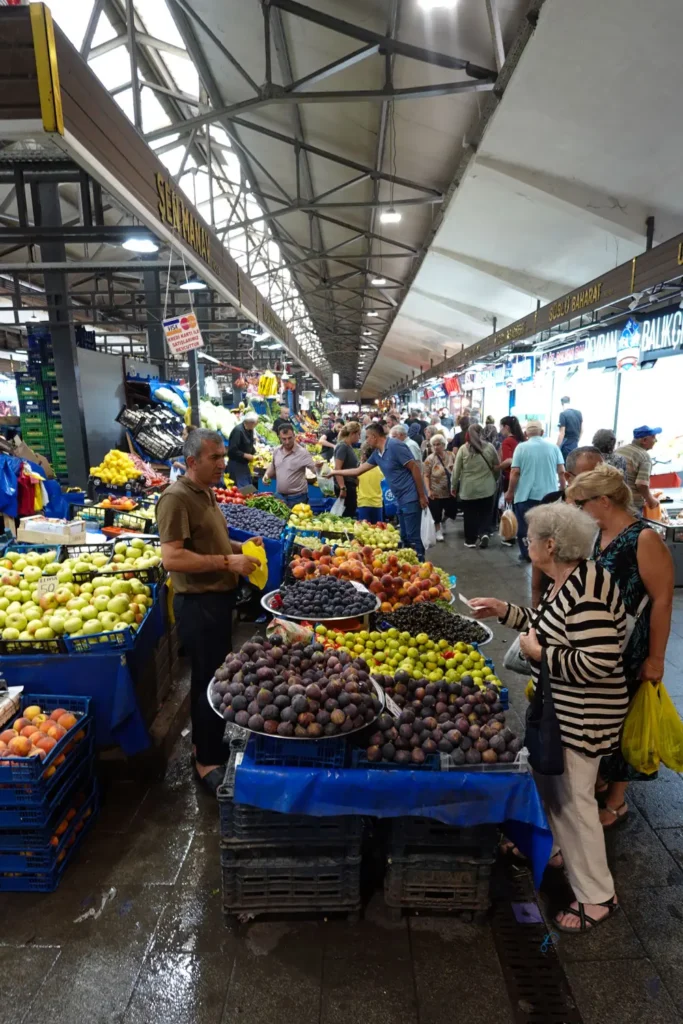
Vegetables and fruit provide much of the visual impact.
Tomatoes, peppers, cucumbers and other produce are displayed in large quantities, and the combination of colour, shoppers and sellers makes this part of the market particularly photogenic.
The important point is not simply that “the market sells vegetables.”
A supermarket does that too.
What changes the experience here is the density of the display and the proximity between produce, sellers and customers.
You are inside the commercial activity rather than looking at it from a distance.
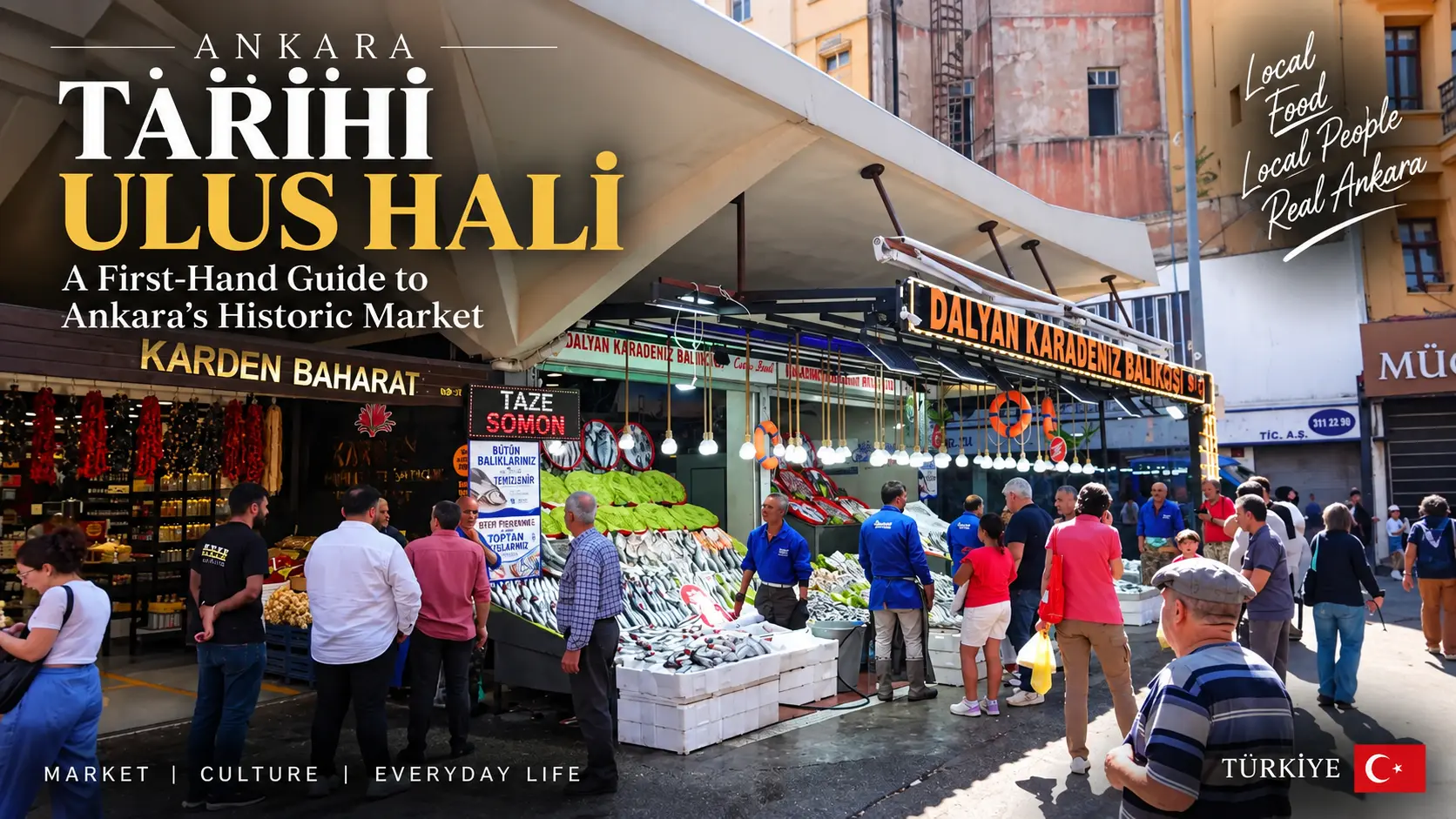
Fish Is a Major Part of the Visual Experience
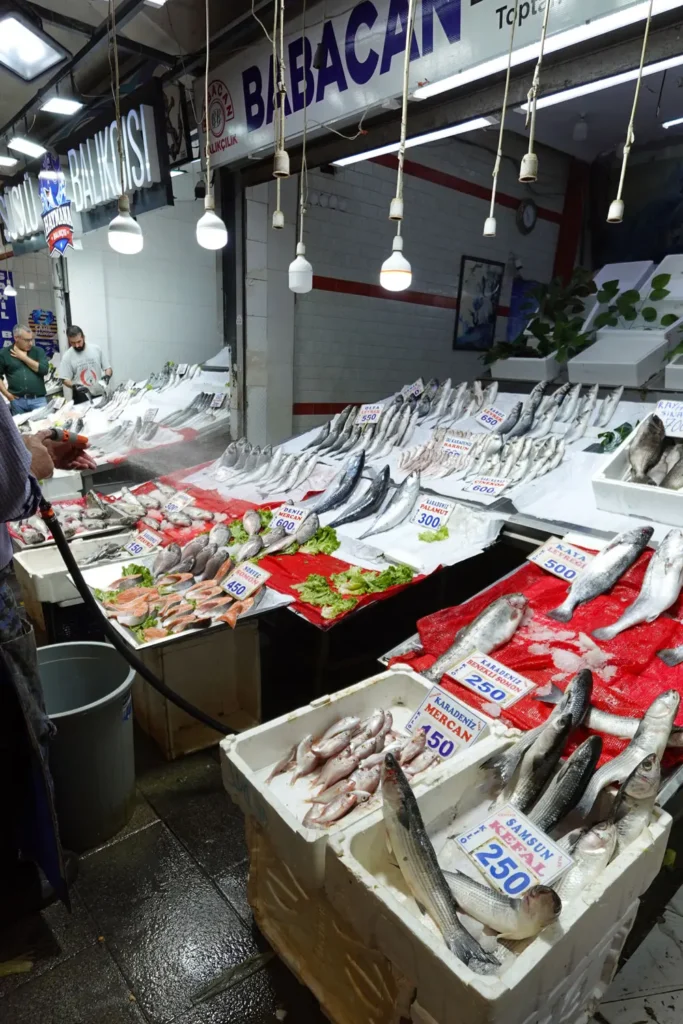
The fish counters provide a completely different atmosphere from the vegetable stalls.
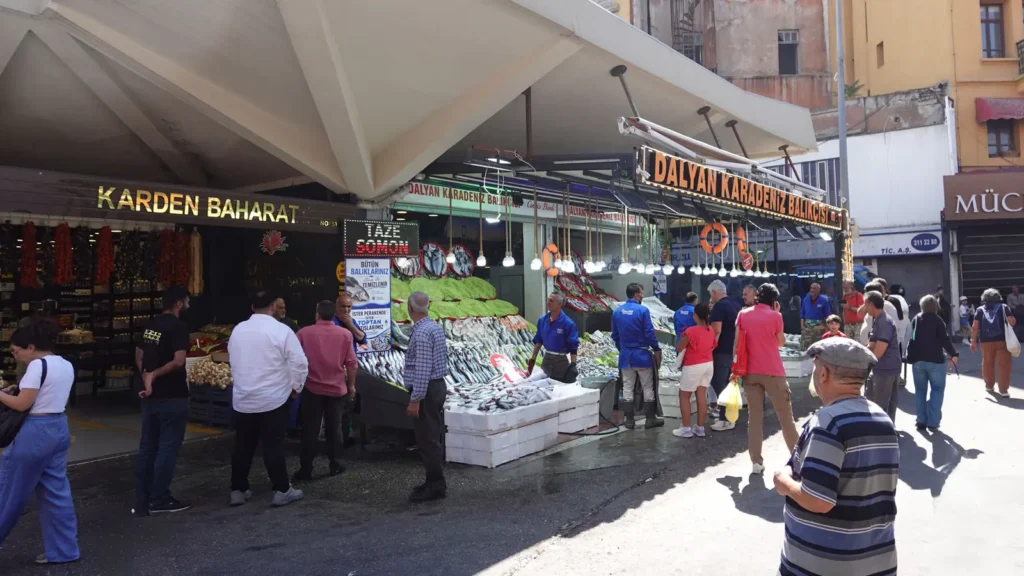
During my visit, numerous fish were laid out on ice with handwritten price labels above them.
I would be careful about using a photograph like this to plan what specific fish will be available or what it will cost when you visit. Species, supply and prices can change.
The photograph is much more useful as evidence of the character of the market: fish is not a minor decorative element here. The fish counters form a conspicuous part of the shopping environment.
For travelers interested in Turkish food culture, that makes the market more informative than a simple produce market.
Spices and Dried Foods Are Worth Looking at Closely
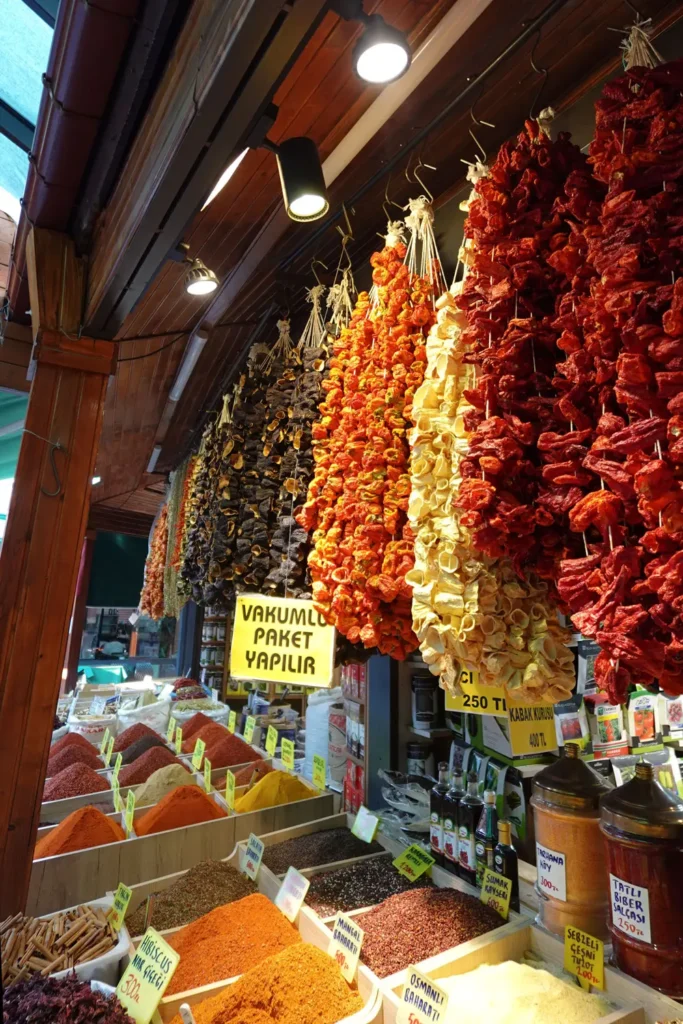
One of my favorite visual details was the spice and dried-food section.
Large strings of dried red, orange, pale and dark vegetables hang above containers of spices and other ingredients.
This is a good place to slow down.
You do not need to identify or buy every product to find it interesting. The displays themselves show ingredients and preservation traditions that may be unfamiliar to visitors who normally encounter Turkish food only after it has reached the restaurant table.
I would avoid guessing the identity of an unfamiliar ingredient from appearance alone. If something interests you, asking the seller is more useful than assuming what it is.
Shopping Here as a Visitor: What I Learned
The market is easy to enjoy without buying anything, but buying something creates a different challenge.
During my visit, cash became an issue for me.
That is a personal experience rather than proof that every stall requires cash, and payment arrangements can vary between businesses. Still, it taught me a practical lesson: I would not arrive assuming that every purchase can be handled exactly as it would be in a large supermarket or shopping mall.
The second lesson was about pace.
Because the market was busy when I visited, I sometimes felt that interactions moved quickly. Looking around first would have made the actual purchasing stage easier.
So my approach for a first visit would be simple:
- Walk through once.
- See what is available.
- Identify the stalls that interest you.
- Then shop.
That also reduces the chance of buying something immediately and discovering a few minutes later that another stall interested you more.
Families should pay particular attention to children when the aisles are busy. During my visit there were many people moving through the same spaces, so keeping children close would be sensible in similar conditions.
Again, that is based on the conditions I personally encountered rather than a claim that the market is always crowded.
What Photographs Do Not Really Show
This is where Ulus Hali becomes more interesting as a travel experience.
The photographs show fruit, vegetables, fish, spices and people very well.
They do not show volume.
They do not show the speed of a conversation with a seller.
They do not show how quickly your attention shifts from one stall to another.
And they cannot reproduce the feeling of standing in a functioning food market where most people around you are there to shop rather than sightsee.
That is the strongest difference between seeing Ulus Hali online and actually entering it.
The market is visually colorful, but its rhythm is more important than its appearance.
For me, that is the main reason to include it in an Ulus itinerary.
Street Food Around Ulus Hali
Food requires a careful distinction here.
The produce, fish and other ingredients shown above were photographed in the market.
The street-food experience described below concerns the area around the market, not necessarily food sold inside Ulus Hali itself.
That distinction matters.
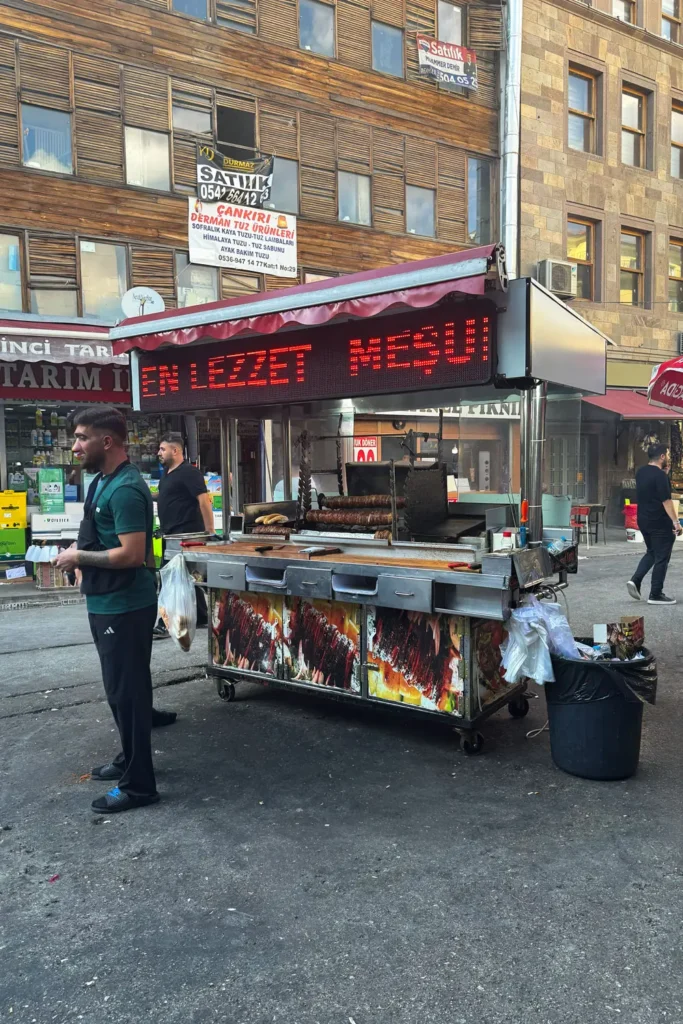
Near the market, I also encountered a street-food stand.
I would not identify the dish or vendor from the photograph alone. Street stalls can change, and a photograph should not be treated as proof that the same vendor will be in the same place when another traveler visits.
But it demonstrates something useful about the neighborhood: the food experience does not necessarily stop when you leave the market building.
The Hamsi Ekmek I Ate Nearby
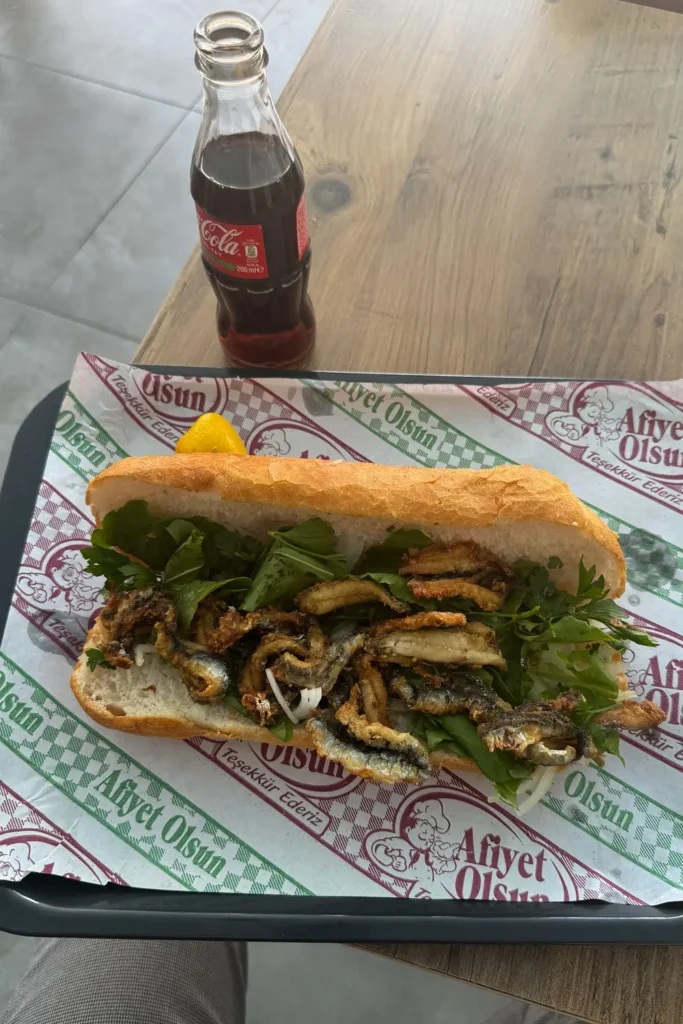
On another visit to the area, I ate hamsi ekmek nearby—a sandwich filled with fried anchovies and greens.
This should not be confused with a claim that hamsi ekmek is an official “Ulus Hali specialty,” or that this particular sandwich is sold inside the market.
I include it for a different reason.
A visit to Ulus Hali can lead naturally into exploring the surrounding commercial streets and trying inexpensive local food. For travelers who enjoy that style of exploration, the market works better as part of the neighborhood than as an isolated destination.
Where Is Tarihi Ulus Hali?
Tarihi Ulus Hali is in the historic Ulus area of Altındağ, Ankara, on Anafartalar Caddesi. If this is your first visit to Ulus, I recommend opening the location on Google Maps before you start walking through the district.
Ulus contains many historic buildings, commercial streets, markets and archaeological sites within a relatively compact area, so having the map available is useful when combining several places on foot.
Getting to Ulus Hali
Tarihi Ulus Hali is on Anafartalar Caddesi in Altındağ, in Ankara’s historic Ulus district. Ankara Metropolitan Municipality gave Anafartalar Caddesi, Altındağ/Ankara as the address in its official reopening announcement.
Ulus is served by Ankara’s metro system. EGO’s official M1 information lists Ulus as a station on the Batıkent–Kızılay route.
For visitors already traveling through central Ankara, metro plus walking is therefore one practical way to reach the wider Ulus area.
I would still check your route on the day of travel. Transport arrangements in the district can change. For example, Ankara Metropolitan Municipality moved a number of Ulus dolmuş services into a new terminal on 15 August 2026; this is a change to local dolmuş arrangements, not to the M1 metro service described above.
How Long Should You Allow?
I would not schedule Ulus Hali in the same way as a major museum.
If you simply want to see the market, walk through the main aisles and take a few photographs, it can be a relatively short stop.
Allow longer if you want to:
- compare stalls or shop;
- photograph the food displays;
- talk with sellers;
- explore the surrounding streets;
- stop for food nearby.
The larger point is that Ulus Hali makes more sense as part of an Ulus walk than as a standalone excursion.
That gives you flexibility. If the market captures your interest, stay longer. If not, continue exploring the historic center.
What to See Near Ulus Hali
One of the biggest advantages of visiting Ulus Hali is its location. You can combine the market with some of the most interesting historic places in Ankara rather than making a separate trip just for the market.
Ulus is one of the strongest areas in Ankara for combining everyday city life with different historical layers. Within the wider district, you can move from a functioning food market to archaeological remains and historic viewpoints.
Ankara Castle
For a wider view of the historic city, continue toward Ankara Castle. The citadel offers a very different experience from Ulus Hali, but the two places work well together: the market shows everyday commercial life, while the castle introduces another layer of Ankara’s long history and urban landscape.
Read my first-hand guide to Ankara Castle →

Roman Baths of Ankara
The Roman Baths of Ankara provide another strong contrast. Instead of a working market, you encounter archaeological remains that reveal Ankara’s Roman past. Visiting both helps show how many different historical layers coexist within the wider Ulus area.
Explore my guide to the Roman Baths of Ankara →

If you have enough time, combining Ulus Hali, the Roman Baths and Ankara Castle creates a much broader picture of Ankara than visiting any one of them alone: ancient history, historic architecture and everyday city life can all be experienced within the same part of the capital.
Who Will Enjoy Ulus Hali Most?
I would particularly recommend it to travelers who enjoy:
- local markets;
- food photography;
- observing everyday city life;
- Turkish ingredients and food culture;
- street-level exploration rather than only major monuments.
It may be lower priority for travelers with very limited time in Ankara who are interested mainly in the city’s major historical monuments or museums.
It may also be less enjoyable for someone who strongly dislikes crowded or noisy spaces. My own visit was busy and energetic, and that was part of what made it interesting—but the same quality will not appeal to everyone.
The market’s value depends on what you are looking for.
Practical Lessons From My Visit
There are several things I would do differently or deliberately repeat next time.
I would first walk through the whole market before buying.
I would make sure I had a practical payment option rather than assuming every seller would accept the method I preferred.
I would leave enough time to look at the fish and spice sections rather than concentrating only on the most colorful fruit and vegetable stalls.
And I would treat the market and its surrounding streets as one experience.
That last point matters most.
Ulus Hali becomes much more interesting when it is not reduced to “a market to photograph.” It provides a transition between historic Ankara and the Ankara in which people still shop, work, eat and move through the same district today.
Discover Ankara Through Barış & Noah
There is another way to continue exploring the atmosphere of Ankara beyond my travel guides.
Barış & Noah is my long-running fictional story set across Türkiye. Ankara is an important part of the wider world surrounding their journey, and the series approaches Türkiye not simply as a collection of tourist destinations, but as a place of streets, encounters, movement, memory and everyday life.
If the local side of Ankara in this article interests you—the markets, older streets and the feeling of moving through the city rather than simply visiting its monuments—you may also enjoy experiencing Türkiye through the fictional journey of Barış and Noah.
The novel is a separate fictional work. It is not a source for the historical or practical travel information in this guide, and this article does not claim that Tarihi Ulus Hali itself appears in the story.
If this is your first time discovering the series, the main page introduces the story and provides the starting point for the episodes.

FAQ
- Is Tarihi Ulus Hali worth visiting?
-
Yes if you enjoy local markets, food culture and everyday city life. I would treat it as part of a wider visit to historic Ulus rather than one of Ankara’s major standalone attractions.
- What can you see inside Ulus Hali?
-
During my visit I saw extensive displays of fresh vegetables and fruit, fish, spices and other food products. Availability can naturally vary.
- Is Ulus Hali touristy?
-
My experience felt much more like entering a working local market than a market arranged primarily for tourists. The people around me were actively shopping and interacting with vendors.
- How long do you need?
-
A straightforward walk through the market does not require a large block of the day. Allow more time if you want to shop, photograph the stalls, explore the surrounding commercial streets or eat nearby.
- How do you reach Ulus Hali?
-
The market is on Anafartalar Caddesi in Altındağ. Ulus is served by the Ankara Metro; EGO lists Ulus station on the M1 line. Check current transport information before traveling.
- Can I pay by card?
-
I would not assume that every seller offers the same payment options. I personally had a problem involving cash during my visit, but that experience should not be generalized to every stall. Check before purchasing.
- Is hamsi ekmek sold inside Ulus Hali?
-
The hamsi ekmek shown in this article is something I ate near the market. I am not presenting it as an Ulus Hali specialty or claiming that the pictured sandwich was purchased inside the market.
FINAL VERDICT
Tarihi Ulus Hali is most rewarding when you understand what it is—and what it is not.
It is not a major Ankara monument that needs hours of sightseeing. Its strongest value is the chance to enter a functioning food market inside a historic 1937 market building and briefly experience a part of everyday commercial life in Ulus.
For food lovers, photographers and travelers interested in ordinary city life, I would include it while exploring Ulus.
For a visitor with very limited time who is focused almost entirely on Ankara’s major museums and historic monuments, it can reasonably take lower priority.
My main advice is simple: do not rush straight to the first stall. Walk through once, look at the produce, fish and spices, absorb the pace, and then decide where you want to stop.
The building is historically interesting. The market’s real value, however, comes from seeing that history still being used.
OFFICIAL SOURCES
Ankara Metropolitan Municipality — Tarihi Ulus Hali Yenileme
Supports the 1937 date, architect Robert Oerley and renovation project status.
Tarihi Ulus Hali renovation project
Ankara Metropolitan Municipality — Tarihi Ulus Hali reopening
Supports the completion of the renovation and reopening in December 2023.
Ulus Hali reopening information
Ankara Miras — Ulus Hali renovation
Supports details of the roof, rainwater infrastructure, central stalls and flooring.
Ankara Miras — Ulus Hali renovation
EGO General Directorate — Ankara Metro M1
Supports Ulus station’s position on the M1 route.
EGO M1 Ankara Metro information
LAST VERIFIED DATE: 21 September 2026