There was no sign it meant to run.
That was what unsettled Barış most.
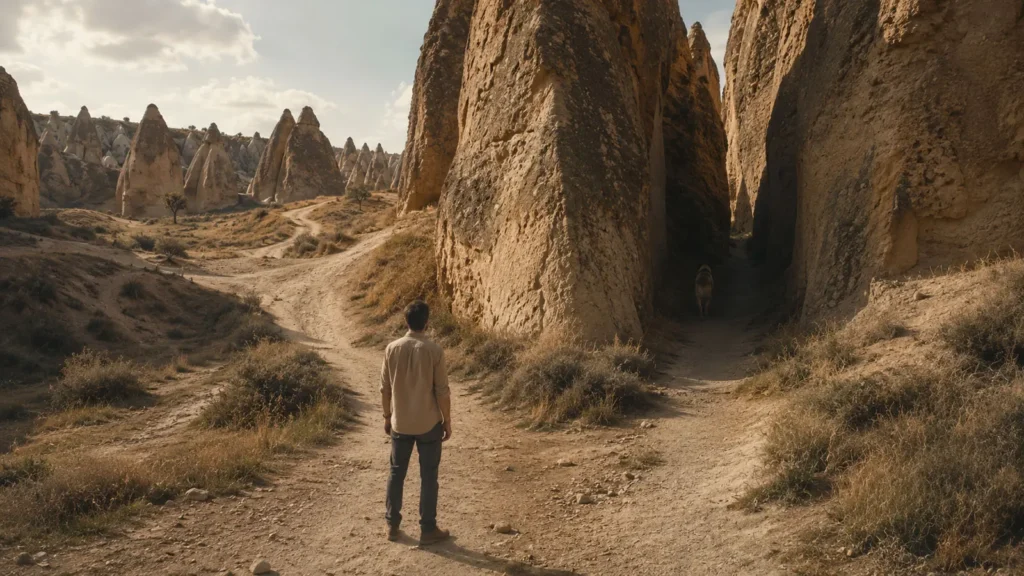
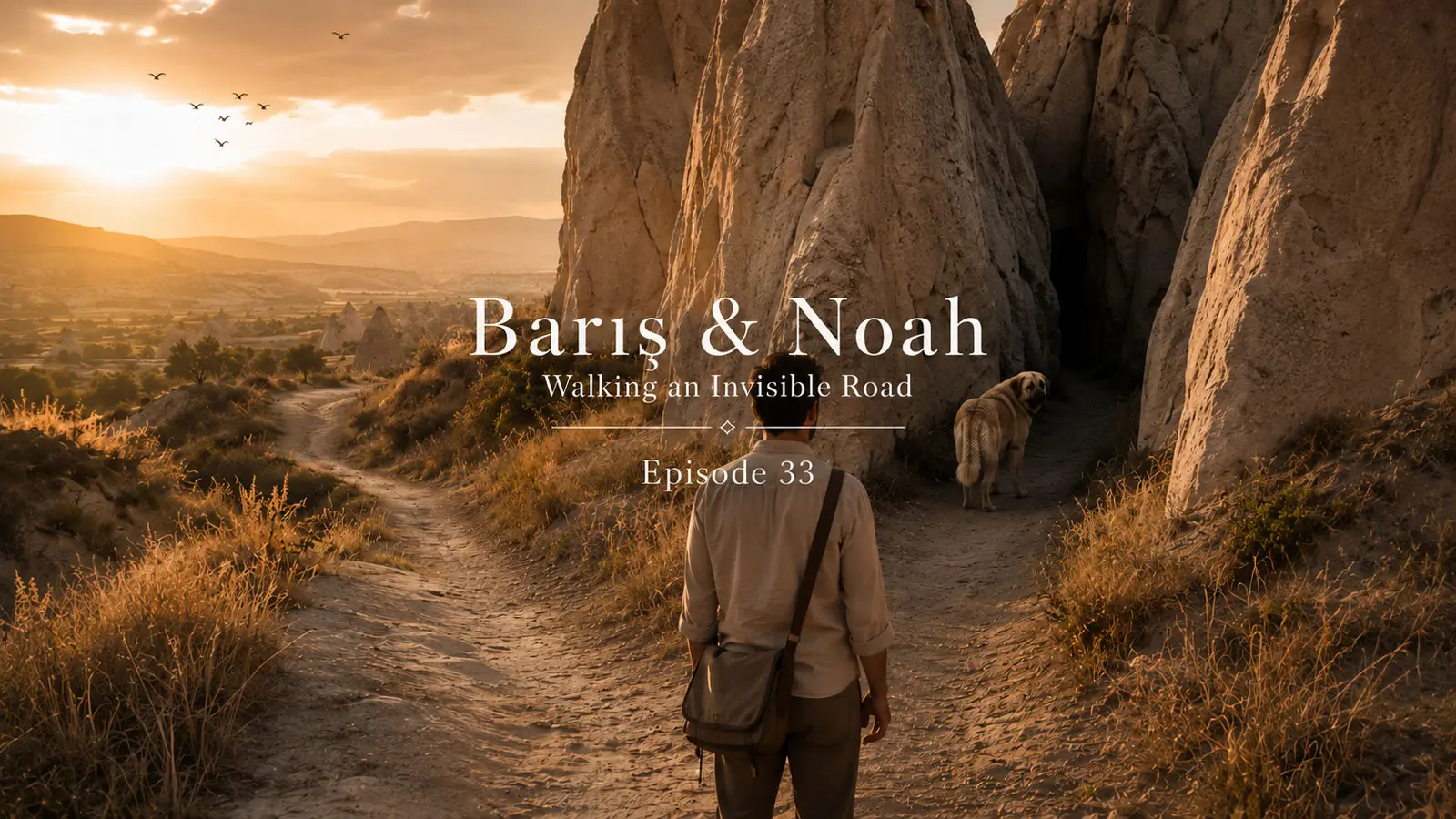
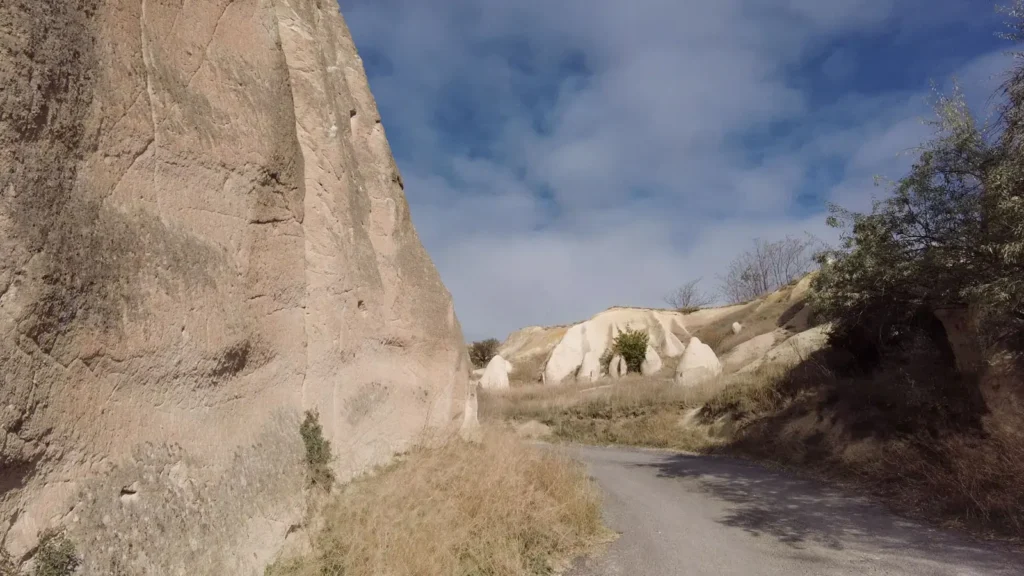
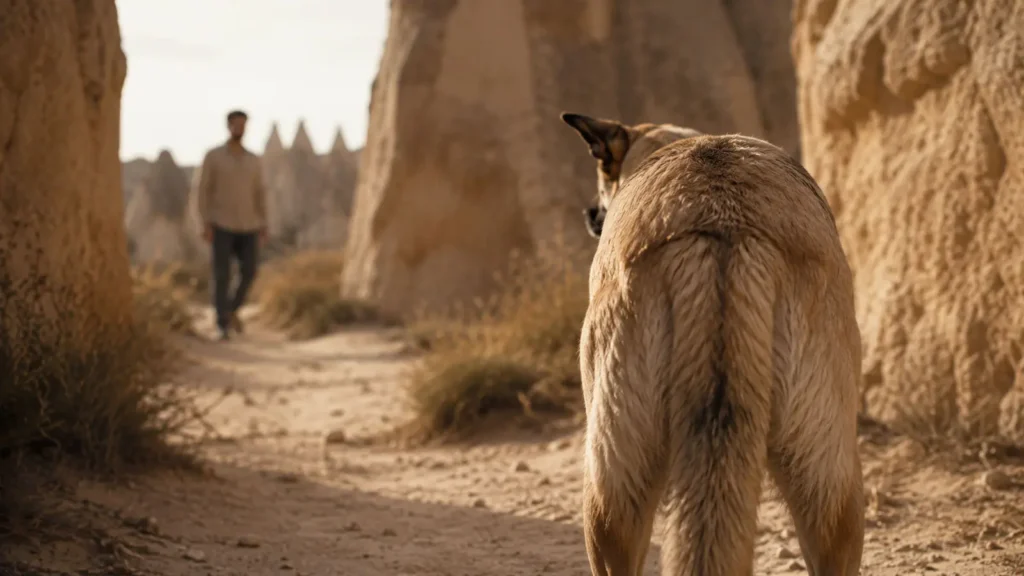
Deep in Love Valley, the dog stood with its back to him. If it had walked away, he could have understood. If it had avoided people, he could have understood. Barking, lowering its body, keeping its distance—those would have been natural.
But the dog did none of those things.
It seemed to know, from the beginning, that there was no need to run.
The morning light had risen higher, and the shadows of the stone pillars were growing shorter. The smell of dry earth carried a faint trace of green grass. Tourists’ voices sounded far away, but they did not reach this place.
Barış looked down at the stone near his feet.
The small stone that had rolled a moment ago had stopped at the edge of the path.
That, at least, was ordinary.
When something moves, it rolls.
When there is a slope, it falls.
But the distance between him and that dog was not ordinary.
Closer or farther, it did not change.
And now, the dog would not run.
Barış took one slow step forward.
The dog did not move.
Another step.
Still nothing.
On the third step, only one of the dog’s ears moved slightly.
That was all.
The small movement made it worse.
It could see him.
It could hear him.
It knew.
And still, it did not run.
Barış’s breath became shallow.
“What are you…”
His voice was taken into the valley air.
The dog did not turn.
It only stood there.
Between the rocks, like a shadow.
Barış remembered the stray dogs he had seen as a child. Dogs in Ankara’s backstreets, coming close to a hand holding bread. If he came too close, they ran. If he chased them, they went farther.
Dogs understood distance with people.
Too close was dangerous.
Too far was unreachable.
Dogs lived by distance.
But this dog was different.
It did not fear distance.
It did not fear people.
Maybe he was the one being measured.
Could he come closer?
Would he stop?
Would he turn back?
Barış closed his hand loosely.
Had his father once stood before something like this?
Unable to move forward.
Unable to return.
The thought cooled something deep in his chest.
He did not want to tie his father to this place.
But since coming to Cappadocia, his father’s absence was no longer only the past.
It had begun to mix with the spaces between rocks, with footsteps, with silence.
Barış looked at the dog.
Its back was still turned.
But it was not indifferent.
Its tail moved slightly.
Maybe the wind.
He tried to think that.
But he could no longer give everything to the wind.
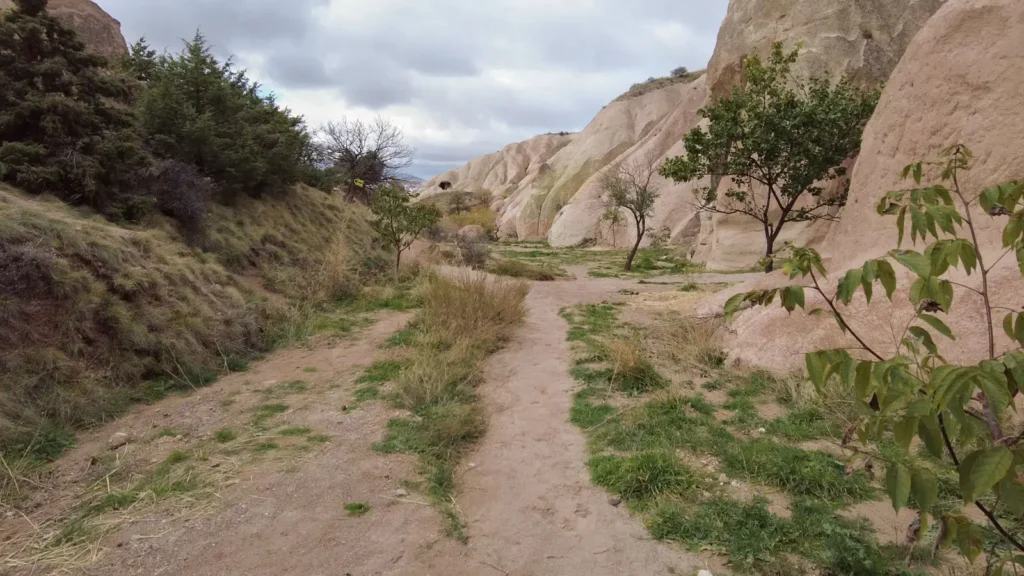
A little farther ahead, the path split in two.
The right path continued deeper into the valley.
The left passed between the rocks and climbed to a slightly higher place.
The dog stood before the fork.
Was it showing him which way to go?
Or was it only standing there?
Barış could not decide.
And that failure to decide pushed him farther forward.
One step.
Then another.
This time, the distance seemed to close a little.
But the dog did not run.
It did not look back.
It only waited quietly, as if it had known he would come.
Then a low voice came from beyond the rock.
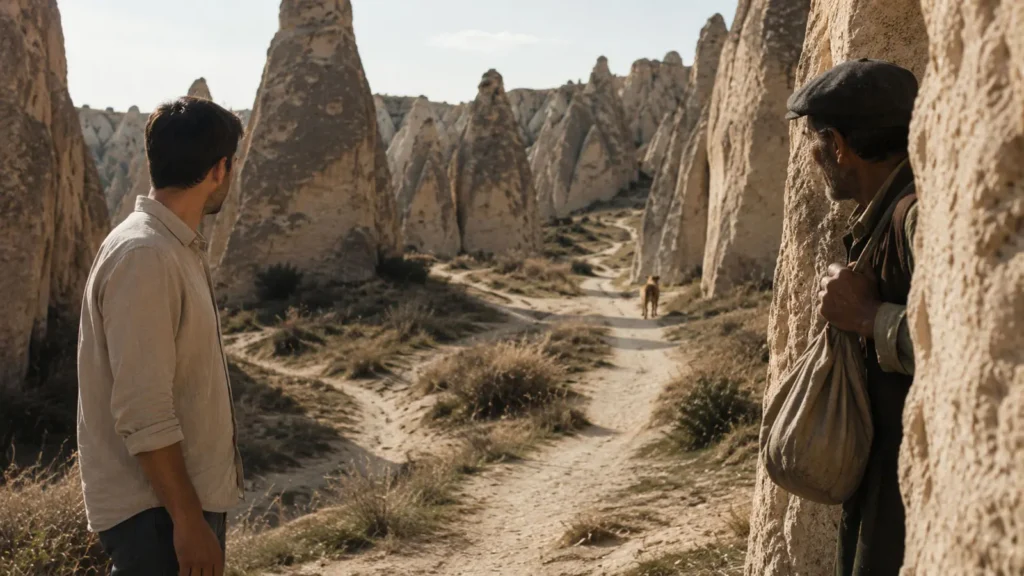
“Is that dog yours?”
Barış turned, startled.
A middle-aged man stood there with an old cloth bag over his shoulder. A local, probably. His face was browned by the sun, with deep lines around his eyes.
“No,” Barış said.
“I don’t know it.”
The man looked at the dog.
“I see.”
That was all he said.
For a while, he was silent.
Barış looked at his profile.
“You can see it?”
As soon as he said it, the question sounded strange.
The man narrowed his eyes a little.
“Of course.”
Then he added, briefly,
“But dogs like that don’t follow just anyone.”
Barış’s throat tightened.
“What do you mean?”
The man shrugged.
“I don’t know what it means. They’ve been around here for a long time. Dogs that look at people.”
“Look at people?”
“People don’t look at the dog. The dog looks at people.”
He said nothing more.
He adjusted the cloth bag on his shoulder and walked slowly between the rocks.
Barış watched him go.
A dog that looks at people.
The words stayed in his chest with an unnatural stillness.
The dog looks at people.
Not chooses.
Not tests.
Only looks.
Barış looked down at his own hand.
For some reason, his palm was damp with sweat.
Fear.
That was what it was.
But it was different from yesterday’s fear.
Not the fear of wanting to run.
The fear of being seen.
As if even the things inside him
were being watched in silence.
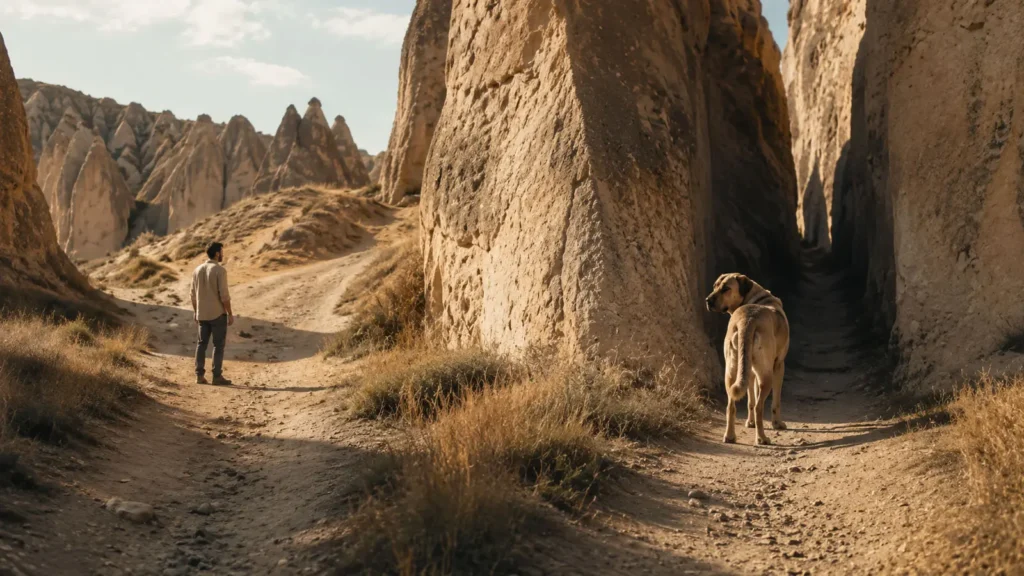
At last, the dog slowly turned its head.
A distant face.
Eyes inside a dark shadow.
Those eyes did not blame Barış.
They did not call him either.
They only seemed to allow him to stand there.
Barış took one more step.
The dog did not run.
In that moment, something small changed inside his chest.
Within the fear, another feeling entered.
I want to know.
Why did it not run?
Why did it appear before him?
Why, each time his father’s memory came closer, did this dog come closer too?
No answer came.
The dog only took one step onto the narrow path on the right.
Then stopped.
Looked back.
Looked at Barış.
Walked again.
Stopped again.
It was not an order.
Too early to call it guidance.
But too late to call it coincidence.
Barış stood before the fork.
Left would take him back toward the road he knew.
Right would mean following the dog.
Wind passed between the rocks.
A dry sound moved through.
Barış looked at the right-hand path.
Narrow.
Dark.
Its end hidden.
At the entrance, the dog waited without running.
As if it already knew
the weakness in Barış
that Barış himself had not yet seen.